
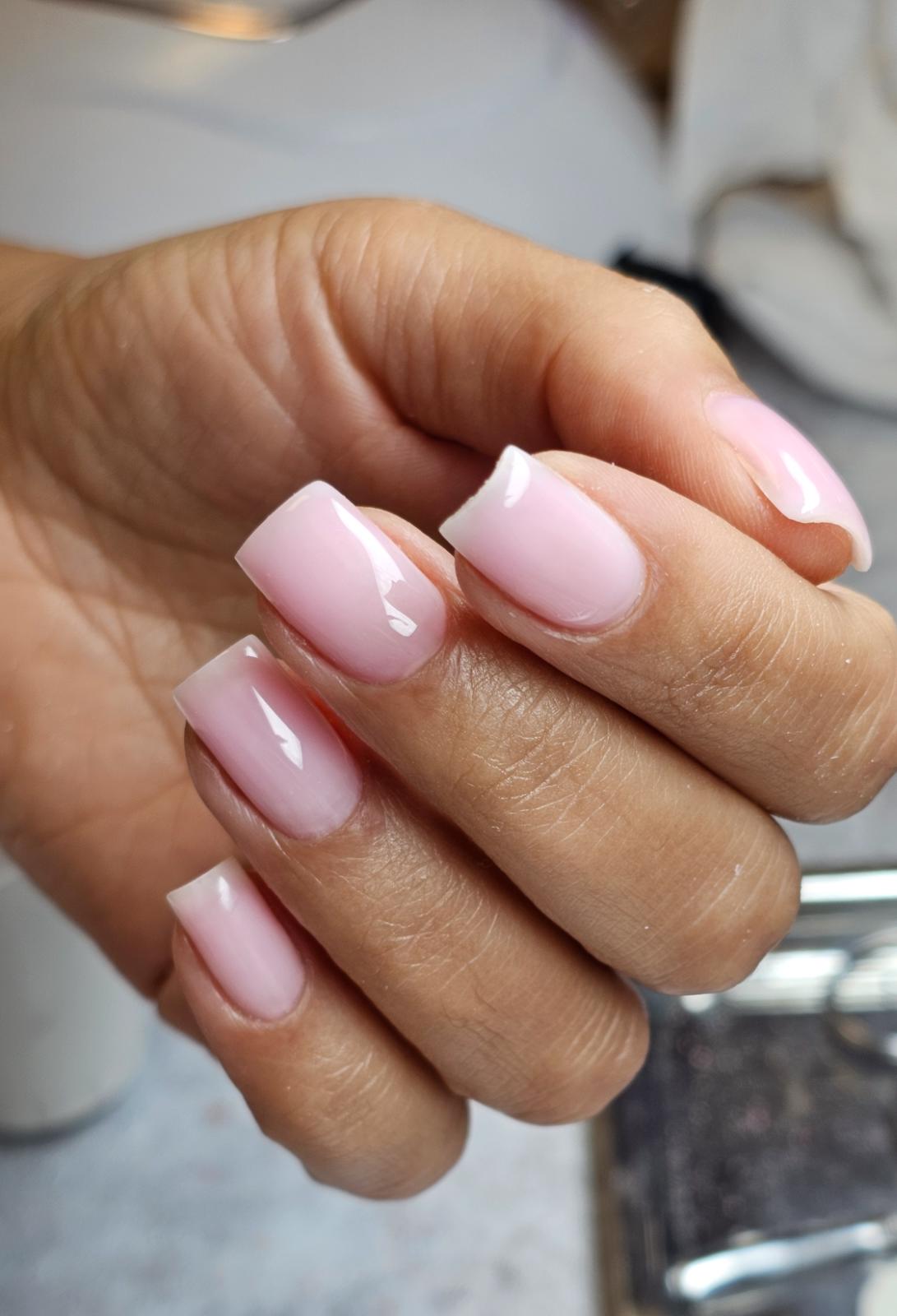
Why does a Russian manicure last so long? The science behind it slug
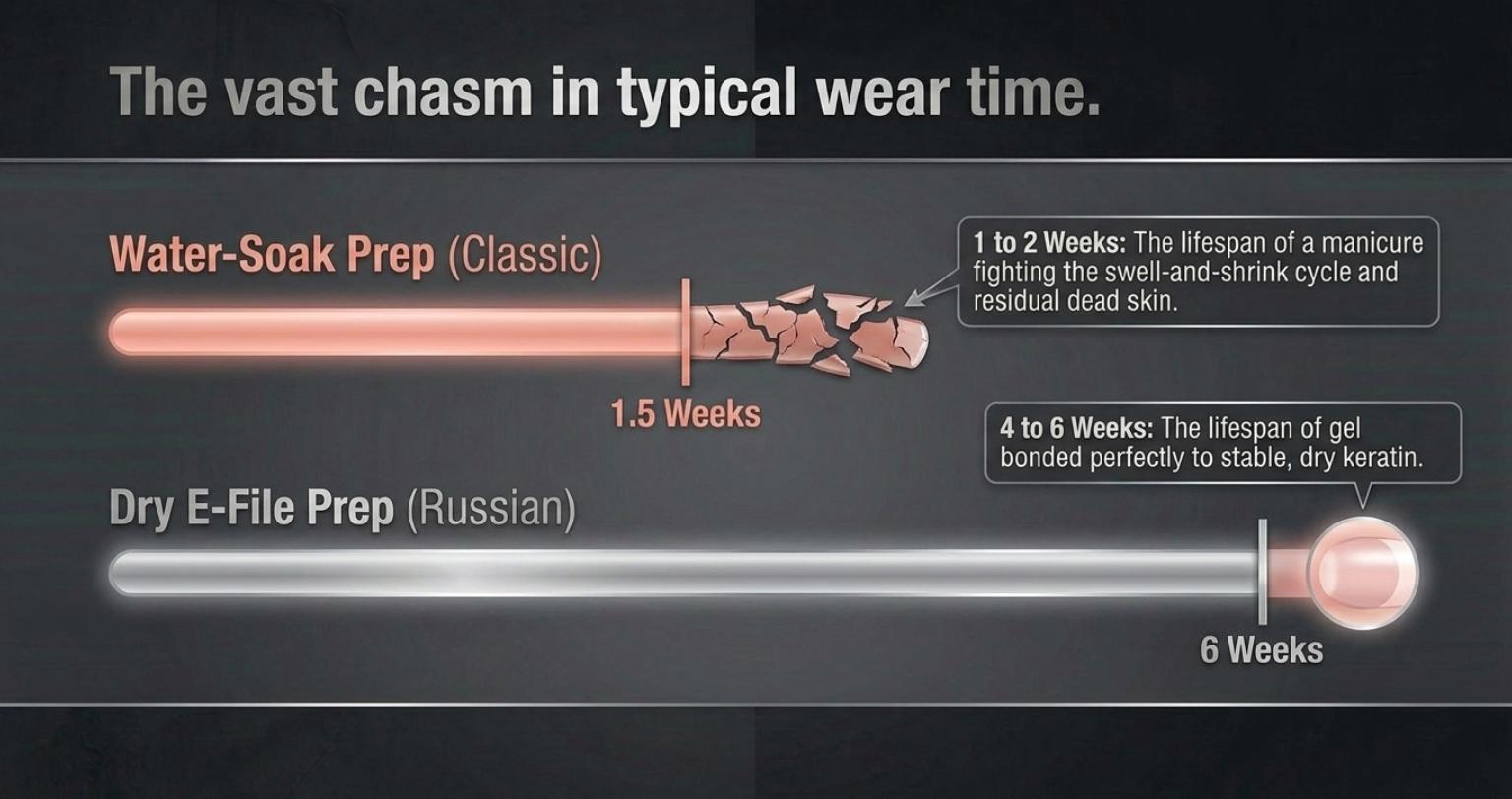
A Russian manicure holds up for 4 to 6 weeks because of how the nail is prepared, not because of anything special in the polish itself. The e-file prep is done completely dry, so the nail never goes through the swell-and-shrink cycle that breaks a fresh coat's bond, and it removes the thin layer of dead skin sitting on the nail plate at the cuticle line, so polish adheres to keratin instead of skin that's about to shed. Both of those, done with a trained hand, are the real difference between a set that's still clean at week 5 and one that's lifting by day 10.
There's no molecular trick hiding in the gel. A dry appointment and a slower, more deliberate pass with a diamond bit do more for wear time than any topcoat on the market. Once you see the mechanics of it, a chipped week-two manicure stops looking like bad luck and starts looking like a nail that was painted on the wrong surface to begin with.
THE SURFACE PROBLEM
Why water is the enemy of a long-lasting manicure
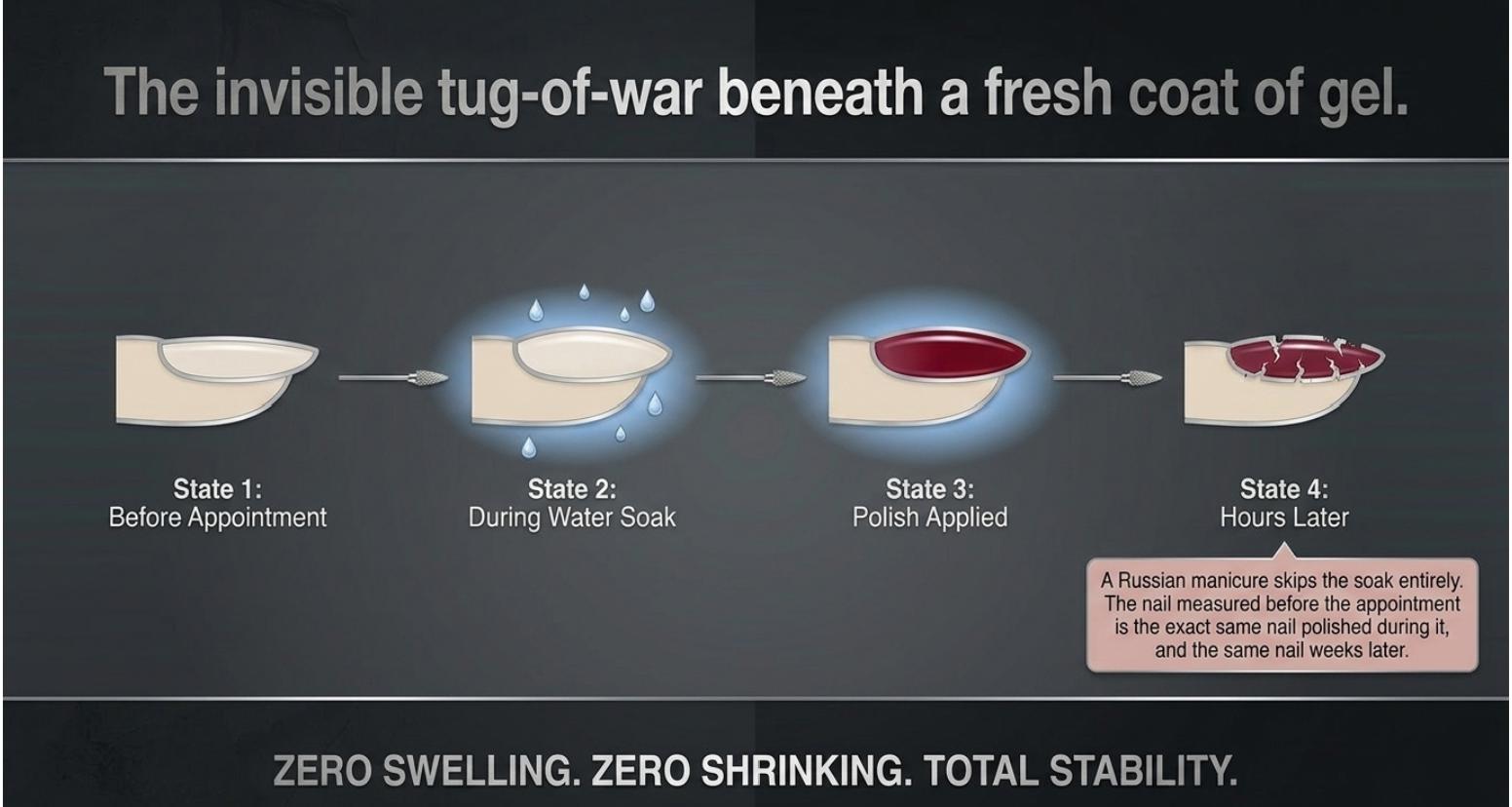
Nail keratin behaves like a sponge. Soak your hands before a manicure and the nail plate absorbs water and swells; over the next several hours, as that water evaporates, the nail shrinks back down. Paint a rigid gel coating onto a nail mid-swell, and the two surfaces are moving at different speeds from the moment the color goes on. Mayo Clinic's nail care guidance is direct on this point: repeated or long contact with water can split fingernails — which is exactly the surface a lasting manicure needs to be stable, not shifting.
A Russian manicure skips the soak entirely. The nail measured before the appointment is the same nail polished during it, and the same nail weeks later. No swelling, no shrinking, no invisible tug-of-war between a rigid coating and a nail plate that's still changing shape underneath it.
THE CUTICLE LINE
Why most manicures fail at the base first
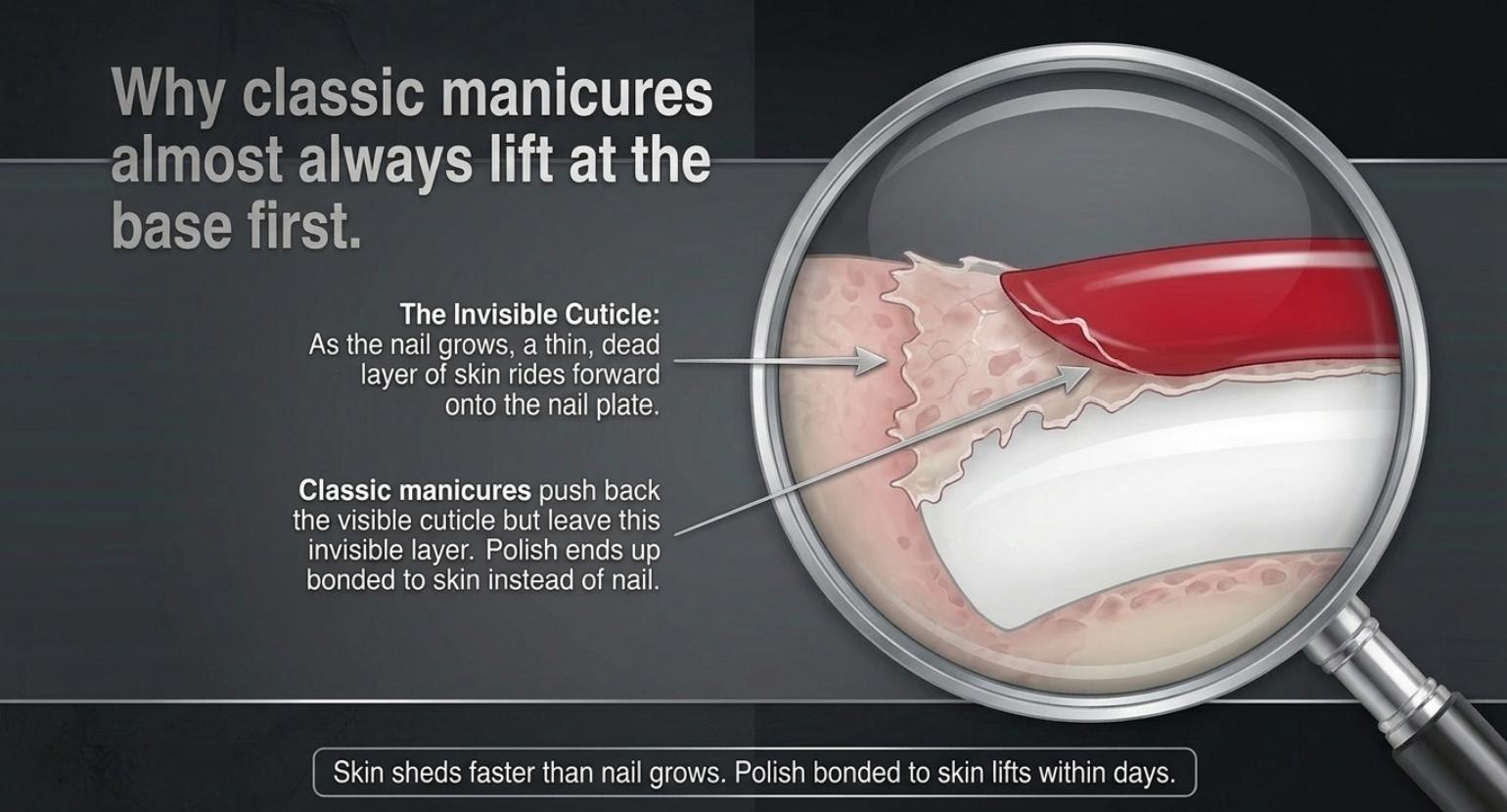
Look closely at where a manicure usually lifts first, and it's almost always right at the cuticle. That's not a coincidence. As the nail grows, a thin, dead layer of skin rides forward onto the nail plate itself — sometimes called the "invisible cuticle." A classic manicure pushes the visible cuticle back but rarely clears this layer completely, so polish ends up bonded partly to skin instead of nail. Skin sheds, and polish bonded to it lifts within days, starting right where you'd expect: at the base.
The e-file work in a Russian manicure is built around clearing that layer precisely, using fine diamond bits to lift dead skin off the nail plate without disturbing the living cuticle underneath. What's left is a clean, fully keratinized surface right up to the fold, so the gel bonds to nail the entire way — not accidentally gripping skin that's already on its way off. It's meticulous work, and exactly why this stays a service for trained hands rather than a shortcut.
That precision matters for more than polish adhesion. The American Academy of Dermatology advises against removing the cuticle altogether, noting that doing so can damage the nail. The goal in a proper Russian manicure was never to strip that seal — it's to clear the dead skin sitting on top of the nail plate while leaving the living cuticle intact. That distinction is the whole job.
TWO WAYS TO PREP A NAIL
Dry e-file prep, side by side with a water soak
| Dry e-file prep | Water-soak prep | |
| Nail plate | Stays a stable size throughout | Swells, then shrinks over hours |
| Cuticle line | Dead skin cleared with diamond bits | Visible cuticle pushed back, residue often remains |
| Where polish bonds | Directly to keratin | Partly to keratin, partly to residual skin |
| Where lifting starts | Rarely at the base | Almost always at the base first |
| Typical wear | 4 to 6 weeks | 1 to 2 weeks |
WHAT CAN SHORTEN (OR EXTEND) IT
Even a perfect set has to survive real life
Good prep sets the ceiling, but daily habits decide whether you actually reach it. Frequent hand-washing, dishwashing, and cleaning products bring the nail back into the water contact dry prep is designed to avoid. Mayo Clinic recommends cotton-lined rubber gloves for dishwashing, cleaning, or chemical use for this reason, and the habit noticeably extends a Russian manicure's wear too. Picking at a lifted edge, rather than having it addressed by a technician, is the other common way a 5-week set turns into a 2-week one.
OUR STANDARD
Why this stays a specialist service at Queen2Be
The line between "cleared the dead skin" and "went too close to the living cuticle" is thin, and getting it wrong isn't just a cosmetic issue — it can open the nail to infection or leave lasting damage to the nail matrix. That's why every technician at Queen2Be trains under Victoria Grizay's standards before an e-file ever touches a client's cuticle. It's also a fair question to bring to any studio: who trained your technician, and how close to the cuticle were they taught to work. If you're weighing your options, how to find a real Russian manicure covers exactly what to check before booking.
COMMON QUESTIONS
Russian manicure longevity questions, answered
Why does a Russian manicure last longer than a regular manicure? It's almost entirely down to prep. The dry, water-free technique avoids the swelling and shrinking that breaks a fresh coat's bond, and the e-file work clears dead skin from the nail plate so polish bonds to keratin instead of skin that's about to shed.
Is it really the polish that makes it last longer? No. The polish and gel systems used are largely the same as in a classic manicure. The longevity comes from the surface it's applied to, not a different product.
How long should a Russian manicure actually last? Most well-executed sets hold up for 4 to 6 weeks, though the cuticle gap becomes more visible as you approach the far end of that range.
Can I make my manicure last even longer? Wearing gloves for dishwashing and cleaning, applying cuticle oil daily, and avoiding picking at any lifted edges are the habits that make the biggest difference between visits.
Is the dry e-file technique safe for my cuticles? Yes, in trained hands. The goal is to remove only the dead skin layer sitting on the nail plate, not the living cuticle that protects against infection — which is exactly why technician training matters as much as the technique itself.
Why does polish usually lift at the cuticle line first? Because that's where a classic prep is most likely to leave polish bonded partly to residual dead skin rather than nail. Skin sheds faster than nail grows, so that's where a manicure typically fails first.
Reserve your Russian manicure
If your last few sets haven't made it past the two-week mark, the fix usually isn't the polish — it's the prep. Book your visit (placeholder link, swap for actual URL) and one of our trained technicians will walk you through what dry e-file prep looks like on your nails specifically.
RELATED READING
- What is a Russian manicure — and why is everyone talking about it?
- How do Russian manicures differ from classic manicures?
- What are the benefits of a dry cuticle manicure?
Queen2Be Beauty Studio · Maple, ON · Toronto North Richmond Hill · Vaughan · and surrounding area Book your visit